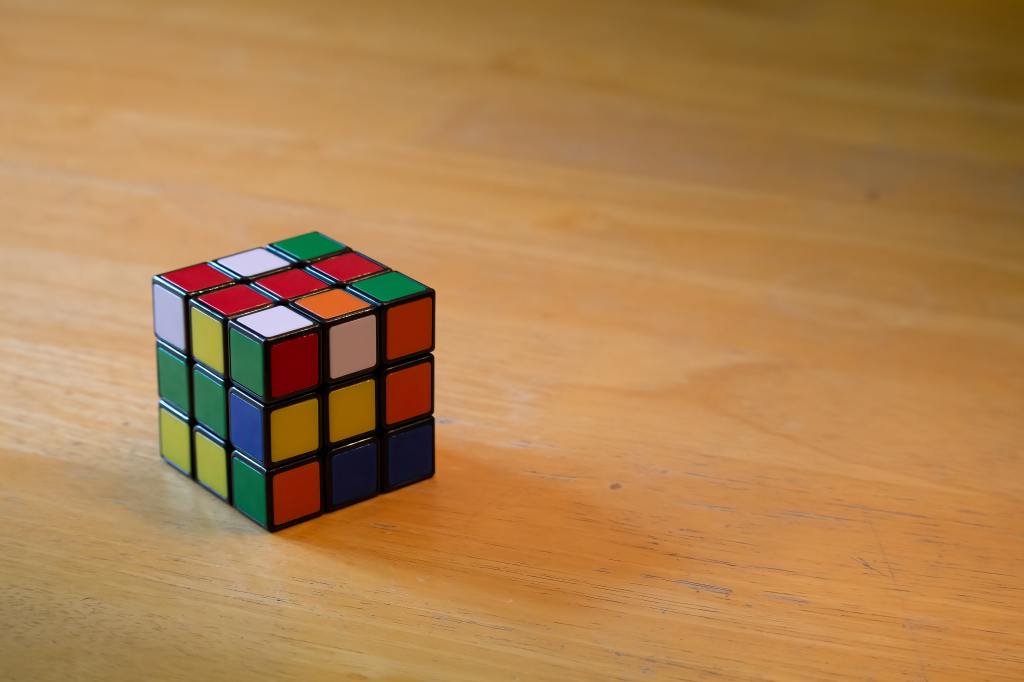
I’m in my physics class. The student to my right is fidgeting with a Rubik’s Cube. I recognize the brand: it’s a Qiyi Valk 3 M.
This surprises me. You don’t see a casual ‘cuber’ solving a Valk 3 M. The Valk 3 M, named after elite ‘speed-cuber’ Mats Valk, is a ‘speed-cube’. It has tiny neodymium magnets in the corner-pieces of the cube to optimize speed. For the average person, solving a Rubik’s Cube is a painstaking enterprise in itself, much less solving it under a time pressure. They don’t require the complex (and expensive) mechanism of a Qiyi Valk 3 for a single solve.
I’m watching him solve the cube. He’s employing a particularly systematic speed-solving method called ‘CFOP’ or Fridrich’s method. First, you solve the first two layers of the cube simultaneously (F2L or First Two Layers). Then, you complete the top face of the cube (OLL or Orientation of Last Layer). Finally, you conclude by solving the last layer (PLL or Permutation of Last Layer).
He reaches the OLL stage of the method, whereby he executes a single algorithm. An algorithm is an operation, or a sequence of turns, that orients the pieces in a specific way. There are 57 different OLL variations, which means memorization of 57 algorithms are needed to complete the OLL step in one algorithm.
A crowd has formed around him. At this point, it’s evident that he’s an experienced speed-cuber, and he knows everything that I know. But the converse isn’t true. To him, I’m one of the many wonderstruck observers. He solves it in around 15 seconds.
“How’d you solve it so fast?” “Isn’t there a trick to doing it?” the crowd inquires.
After the clamor died off, I ask to solve it. Everyone’s eyes are on me. I scramble the cube in preparation for my solve. The cube is lubricated, and the tensions are adjusted nicely. This guy takes his craft seriously.
Someone pulls out their timer. I examine the cube for 15 seconds and get to solving. I finish the first two layers. Then, I orient the last layer. I glance up at the cube’s owner. He’s watching me blankly, but his thoughts are thinly veiled.
He knows that I’m “in the know”- just as I knew he was “in the know”.
I finish my solve in 17 seconds and return to him his cube. Which means in a grand total of 32 seconds, we were able to communicate our shared enthusiasm in cubing, demonstrate our mutual belonging towards a combination puzzle community, and display our commitment towards improving our speed-cubing skills.
It almost felt ritualistic. Or cult-like. For instance, freemasons have various esoteric ways of formally identifying one another. Gangsters have specific hand-gestures or ‘gang-signs’ to demonstrate affiliation towards a specific gang.
If you don’t have specialized knowledge or aren’t “in the know”, cubing can be reduced to an impressive party trick. And for a hobby as niche as speed-cubing, specialized knowledge can only be obtained through deliberation. As with all things in the world, cubing has nuance. It’s impossible to ‘accidently’ learn about cubing, at least, as easily as something with the ubiquity of, say, professional sports.
After I handed to the student his cube, we had an erudite conversation on our cubing journey, what our favorite cubes are, which cubing youtubers we enjoy the most, etc. I felt that this was a microcosm of a larger picture regarding social interaction.
We humans like to divide ourselves into tribes. These tribes are constructed based on similarities, whether that pertains to interests, culture, experience, etc. At our core, we’re all amalgamations of our various tribes.
We all have overlapping tribes. Some tribes are bigger, and some are smaller. When we communicate our tribes effectively, they can lend themselves as a bridge for meaningful social interaction.
In a social setting, we typically engage in small talk with others in search of a common tribe. What’s special about cubing as a hobby is the fact that all the necessary communication can be encapsulated in a quick solve. It’s one of the perks of having your community revolve around a children’s toy.
 Rohit Ramaswamy's Blog
Leave a comment